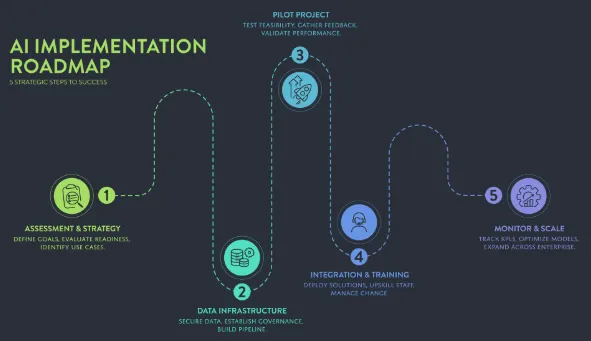
Beyond the Pilot: How to Build a Winning Enterprise AI Strategy
Up to 95% of custom enterprise AI initiatives stall in the "pilot trap"—delivering impressive internal demos but failing to achieve measurable P&L impact at scale.
asd
The era of scattered chatbots and uncoordinated point solutions is over. A winning AI strategy isn't about deploying the newest model; it's about building a repeatable operational playbook that connects technology to concrete business outcomes, robust governance, and scalable workflows.
The 5 Pillars of a High-Impact AI Strategy
asd
1. Anchor AI directly to Business Outcomes
Starting with the technology rather than the problem is the primary reason AI programs fail. A winning strategy begins with clear business objectives:
Identify core bottlenecks: Target high-cost, high-frequency processes across departments.
Define success in hard numbers: Establish quantitative baseline KPIs—such as a 35% reduction in cycle time or a 20% improvement in customer retention—before writing a single line of code.
Secure executive sponsorship: Ensure every AI initiative has an accountable business owner, not just an IT sponsor.
asd
2. Audit and Prep Your Data Infrastructure
AI is only as good as the data powering it. Deploying advanced models on fragmented, poor-quality data leads to unreliable outputs and compliance risks.
Access & Governance: Integrate strict identity and access controls to ensure sensitive customer or proprietary data remains protected.
Architecture Strategy: Decide early between public cloud APIs, hybrid Virtual Private Clouds (VPC), or on-premises solutions based on your industry's regulatory requirements.
asd
3. Prioritize with a Value-vs.-Feasibility Matrix
Avoid trying to solve every problem at once. Map potential AI opportunities into a clear decision framework:
Pilot First: Generates early momentum and proves ROI.
Strategic BetsHigh business impact, lower technical feasibility
Stage Carefully: Address data infrastructure gaps before building.
Fill-insLow impact, high feasibility
Automate Opportunistically: Do not dedicate core engineering time.Money
PitsLow impact, low feasibility
Decline or Defer: Eliminate to prevent resource drain.
asd
4. Build Governance and Oversight into the Lifecycle
As organizations shift toward multi-step autonomous AI agents, governance can no longer be an afterthought.
Human-in-the-Loop Checkpoints: Mandate human review for high-risk decisions, customer-facing content, or financial actions.
Observability & Guardrails: Track model accuracy, latency, and safety violations continuously to catch drift or bad outputs early.
asdadsasd
5. Redesign Workflows and Elevate Talent
Deploying AI tools without changing how people work yields marginal productivity gains. True value comes from reimagining end-to-end workflows:
Raise AI Fluency: Invest in persona-based training across teams so employees understand how to prompt, verify, and collaborate with AI tools.
Workaround Redesign: Remove friction by integrating AI directly into existing enterprise systems (CRMs, ERPs) rather than forcing staff to switch between standalone tools.
asd
Executive Checklist for AI Readiness
asd
The 30-Day Sanity Check:
[ ] Do we have 3–5 board-approved business metrics that AI must move this year?
asd
[ ] Is data permission and structured to prevent unauthorized exposure?
asd
[ ] Have we defined go/no-go gates for transitioning pilots into full production?
asd
[ ] Are we monitoring operational cost, speed, and output quality in real time?
asd
By anchoring technology choices to core financial goals, instituting clear governance, and preparing workforce workflows, leadership can transition AI from an experimental line item into a sustainable competitive advantage.